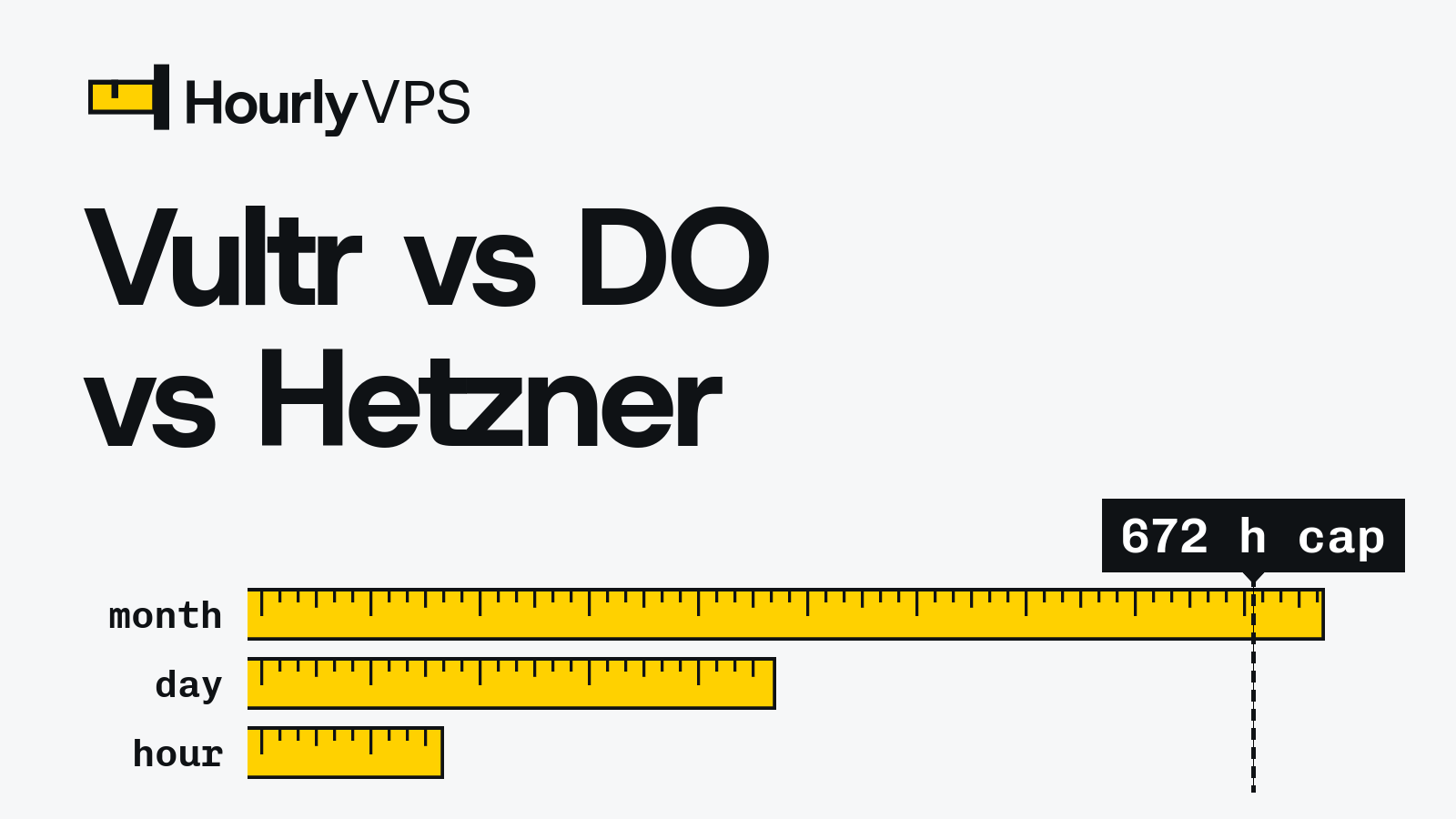
Vultr vs DigitalOcean vs Hetzner comes down to a few billing rules: DigitalOcean bills Droplets per second with a minimum charge of 60 seconds or $0.01, while Vultr and Hetzner Cloud bill every started hour. DigitalOcean and Vultr stop charging at 672 hours a month on their standard plans, Hetzner stops at each server’s monthly price, and all three keep billing a stopped server until you delete it.
In short: DigitalOcean suits many short-lived servers, Vultr suits global reach and crypto payments, and Hetzner suits always-on servers in Europe that push a lot of traffic, although its June 2026 price rise closed most of the gap on its CPX line. Every figure below comes from the providers’ own pages, checked in October 2026, and from our Hourly VPS Fine-Print Index.
Key takeaways
- DigitalOcean has billed Droplets per second since January 1, 2026, with a 60-second or $0.01 minimum per Droplet; Vultr and Hetzner Cloud bill every started hour.
- DigitalOcean and Vultr cap standard plans at 672 hours a month; Hetzner caps at each server's monthly price, about 624 hours at current list prices (our arithmetic).
- All three bill a stopped server in full until you delete it, and Hetzner also bills its €0.50/month Primary IPv4 until that IP is deleted.
- After Hetzner's June 15, 2026 price change, a 2 vCPU / 4 GB CPX22 with IPv4 costs $23.59/month on a USD account, close to DigitalOcean's $24 and above Vultr's $20.
- Vultr and DigitalOcean do not offer refunds; Hetzner pays out leftover credit only after the account is fully closed.
Vultr vs DigitalOcean vs Hetzner billing at a glance
One row per rule. Prices are list prices in the provider’s currency, excluding VAT, as of October 3, 2026, for DigitalOcean’s bundled Droplets, Vultr’s shared-CPU Cloud Compute and Hetzner’s cloud servers.
| Rule | DigitalOcean | Vultr | Hetzner Cloud |
|---|---|---|---|
| Billing unit | Per second; minimum charge 60 seconds or $0.01 per Droplet, whichever is higher | Per hour; minimum billing unit is one hour | Per hour; usage always rounded up to a full hour |
| Monthly cap | 672 hours (28 days) on bundled plans; v5 Droplets have no cap | 672 hours on Cloud Compute; VX1 and GPU billed for actual hours | The server’s monthly price; about 624 hours at current list prices (our arithmetic) |
| Stopped server | Billed in full until destroyed | Billed in full until destroyed | Billed in full until deleted |
| Public IPv4 | Included on bundled plans; v5 Droplets list it separately at $0.00/hour for now | One included; the $2.50/month plan is IPv6-only | Extra: €0.50/month (€0.0008/hour) or $0.60/month; IPv6 free |
| 2 vCPU / 4 GB shared plan | $24.00/month ($0.03571/hour), 80 GiB, 4,000 GiB transfer | $20.00/month ($0.03/hour), 80 GB, 3 TB transfer | CPX22: €19.49/month (€0.0312/hour) + IPv4, 80 GB, 20 TB in the EU; $22.99 on USD accounts |
| Lowest listed hourly price | $0.00595/hour: 1 vCPU, 512 MiB, 10 GiB ($4.00/month) | $0.004/hour: 1 vCPU, 0.5 GB, IPv6-only ($2.50/month, 2 per account) | €0.0088/hour: CX23, 2 vCPU, 4 GB (€5.49/month); its line was marked not available on October 2, 2026 |
| How you pay | Post-paid monthly; new accounts may be charged mid-month at $25 | Card or PayPal linked at signup; usage invoiced on the 1st of each month | Invoiced in arrears; card charged a few days after the invoice |
| Deposit | None on Tier 1; PayPal $5 and crypto $25 authorizations | None published | None published; fraud checks may ask for ID or a card prepayment |
| Payment methods | Cards, PayPal, Google Pay, Apple Pay, Alipay, Link, stablecoins (limited), ACH (US) | Cards, PayPal, Alipay, crypto via BitPay, wire transfer, gift codes | Cards, SEPA direct debit (EUR), bank transfer, PayPal (manual); no crypto |
| Unused credit refund | No: “We do not offer refunds.” | No: “we do not offer refunds.” | Paid out only after the account is fully closed |
| Traffic overage | $0.01 per GiB outbound; allowance pooled per team | $0.01 per GB outbound; allowance pooled, plus 2 TB free per account | Billed per TB in 100 MB blocks; at least 20 TB included in the EU |
| API | REST API, doctl CLI | REST API v2, CLI, Terraform | REST API, hcloud CLI |
| Locations | 16 data centers in 13 regions | 33 regions | 6 locations in 4 network zones |
How these facts were checked: DigitalOcean’s pages were read live on October 3, 2026. Vultr and Hetzner block automated requests from our server, so their FAQ, pricing and docs pages were read from Internet Archive captures dated August 1 to October 2, 2026; Vultr’s region count and plan list were also checked against its public API on October 3. Every cell, with its source link and date, is in the Fine-Print Index, which takes corrections.
Which should you choose? Where each provider is a better fit
Pick by the job, not the brand. Each row names the provider whose published rules suit that job and the rule that decides it.
| If you need | Better fit | The rule that decides it |
|---|---|---|
| Many short-lived servers: CI jobs, batch work, autoscaling | DigitalOcean | Per-second billing with a 60-second or $0.01 minimum per Droplet |
| A 2 vCPU / 4 GB server at the lowest US-dollar list price you can order | Vultr | $20/month, against $24 at DigitalOcean and $23.59 for Hetzner’s CPX22 with IPv4; Hetzner’s CX23 ($7.09 with IPv4) was marked not available |
| A region outside Europe and North America, such as Johannesburg, São Paulo, Santiago, Mumbai or Tel Aviv | Vultr | 33 regions on six continents |
| To pay with cryptocurrency | Vultr, or DigitalOcean where offered | Vultr lists nine coins through BitPay; DigitalOcean’s stablecoin option is limited by location; Hetzner takes no crypto |
| The lowest always-on price in Germany or Finland | Hetzner, when its CX or CAX servers are in stock | CX23 caps at €5.49/month plus €0.50 for IPv4, but the line was marked not available on October 2, 2026 |
| A lot of outbound traffic from Europe | Hetzner | At least 20 TB included per EU server, against 3 to 4 TB on the comparable Vultr and DigitalOcean plans |
| Post-paid billing with no deposit, paid by wallet or US bank debit | DigitalOcean | Tier 1 needs no prepayment; Google Pay, Apple Pay, Link and ACH are accepted |
| SEPA direct debit or one invoice after the month | Hetzner | Billed in arrears; SEPA for EUR accounts |
How does each provider bill: per second or per hour?
DigitalOcean moved Droplets to per-second billing on January 1, 2026; its pricing docs set the minimum charge at 60 seconds or $0.01, whichever is higher, and the minimum applies to each Droplet.
Vultr’s FAQ says: “The minimum billing unit for all servers is one hour.” Hetzner’s billing FAQ is just as direct: “We always round up the hourly usage of a server. If you create a server just for a few minutes, we will still bill you for one whole hour.”
In practice, a 10-minute job costs one cent on a small DigitalOcean Droplet (the $0.01 floor) and a full hour on Vultr or Hetzner. For a server that lives for days, the gap shrinks to the last partial hour. The per-second vs per-hour billing guide works through more cases.
Why Vultr shows two hourly prices
Vultr’s pricing page lists its 2 vCPU / 4 GB Regular Performance plan at $0.03/hour, while its public API lists the same $20.00/month plan at $0.027/hour. The API figure is the monthly price spread over 730 hours; the pricing-page figure fits the FAQ’s 672-hour cap, since $0.03 × 672 hours comes to about $20 (our arithmetic). Vultr does not say which rate its invoices use, so the worked examples below use the pricing-page rate.
When does the monthly cap kick in?
All three stop the meter at a monthly ceiling, but at different hours. For a server that runs most of the month, the cap is the real price and the hourly rate only sets how fast you reach it.
| Product | Cap | Hours to reach it | Hours not charged in a 30-day month (720 h) |
|---|---|---|---|
| DigitalOcean bundled Droplets | 672 hours | 672 h (28 days) | 48 |
| DigitalOcean v5 Droplets | None | n/a | 0 |
| Vultr Cloud Compute | 672 hours | 672 h (28 days) | 48 |
| Vultr VX1 and GPU | None; actual hours on a 730-hour model | n/a | 0 |
| Hetzner Cloud | The server’s monthly price | About 624 h (26 days): €5.49 ÷ €0.0088 for CX23, €19.49 ÷ €0.0312 for CPX22 | About 96 |
Hetzner puts it plainly: “Your server’s bill will never exceed its monthly price cap.” A Hetzner server that runs all month is billed the monthly price, not 720 hours. The hourly VPS billing guide explains how caps, increments and stopped servers interact.
What does a short job cost on each? Worked examples
The same workloads priced on comparable 2 vCPU / 4 GB shared-CPU plans. Disk and included traffic differ (last row), so read this as a comparison of billing rules more than of value. All figures are our arithmetic from list prices, excluding VAT.
| Workload | DigitalOcean Basic, 2 vCPU / 4 GiB ($0.03571/h, $24/mo) | Vultr Regular, 2 vCPU / 4 GB ($0.03/h, $20/mo) | Hetzner CPX22 + IPv4 (€0.0320/h, €19.99/mo) | Hetzner CX23 + IPv4 (€0.0096/h, €5.99/mo)* |
|---|---|---|---|---|
| One 10-minute job | $0.01 (minimum charge) | $0.03 | €0.032 | €0.0096 |
| One job of 2 h 5 min | $0.07 | $0.09 (3 hours) | €0.096 (3 hours) | €0.029 (3 hours) |
| 600 ten-minute jobs a month, a fresh server each time | $6.00 | $18.00 | €19.20 | €5.76 |
| A 3-day test (72 hours) | $2.57 | $2.16 | €2.30 | €0.69 |
| Always on for a 30-day month | $24.00 (cap) | $20.00 (cap) | €19.99 (caps) | €5.99 (caps) |
| Included disk and outbound traffic | 80 GiB SSD, 4,000 GiB | 80 GB, 3 TB | 80 GB NVMe, 20 TB (EU) | 40 GB NVMe, 20 TB (EU) |
Two patterns stand out. With per-hour billing, 600 fresh 10-minute servers cost about as much as one server left on all month, so a long-lived runner or batched jobs cost less. With per-second billing the same 600 jobs cost a quarter of the monthly cap, and the $0.01 floor, not the clock, sets the price of each job. If you run CI this way, our guide to ephemeral GitHub Actions runners on a VPS shows both setups.
Is Hetzner still the low-cost option after its June 2026 price change?
Only on its cost-optimized line, and only when it is in stock. Hetzner’s June 15, 2026 price adjustment raised CPX22 in Germany and Finland from €7.99 to €19.49 a month (€0.0128 to €0.0312 an hour) and CX23 from €3.99 to €5.49, for new orders and rescales. Comparisons written before mid-June 2026 quote the old prices.
On a USD account, CPX22 with its IPv4 now lists at $23.59 a month ($22.99 plus $0.60), within a dollar of DigitalOcean’s $24 Droplet and above Vultr’s $20 plan. CX23 keeps a wide lead at €5.99 with IPv4, but Hetzner’s Cloud page marked the Cost-Optimized line “Currently not available” on October 2, 2026 (Internet Archive capture), and the CX and CAX types run only in Germany and Finland, per its locations page. Servers you already run keep their old price until you rescale them, restore them after deletion or move them to a project in another currency.
Do Vultr, DigitalOcean and Hetzner charge for stopped servers?
Yes, all three. Vultr says stopped instances “continue to reserve dedicated system resources (RAM, SSD storage, IP aliases, vCPU) and therefore incur charges until you destroy the instance.” DigitalOcean bills powered-off bundled Droplets “because the compute resources stay reserved on the hypervisor.” Hetzner bills a server “for as long as it exists, regardless of whether it is turned on or not.”
The way out is the same everywhere: snapshot, delete, and restore later. Snapshots have their own price: Vultr lists $0.05 per GB per month, DigitalOcean $0.06 per GB per month, and Hetzner bills the compressed snapshot size per GB per month. Our guide to which providers bill stopped servers covers 20 providers, and the checklist for deleting a VPS lists what to save first.
IPv4, bandwidth and backups: the line items around the server
IPv4 fees
Hetzner bills servers and Primary IPs separately: a Primary IPv4 costs €0.50/month (€0.0008/hour) or $0.60/month, and IPv6 is free. Its billing FAQ adds that a Primary IP is billed until you delete it, even when it is not assigned to any server, so check for leftover IPs after you delete a server. Dropping IPv4 removes the fee, but clients without IPv6 then cannot reach the server directly.
DigitalOcean includes IPv4 on bundled Droplets; on its newer v5 Droplets the address is a separate invoice line, listed at an introductory $0.00/hour that is “subject to change”. Vultr includes one IPv4 on standard plans, and its FAQ says up to two more “are available for an extra fee” without stating the amount.
Traffic allowances and overage
DigitalOcean charges $0.01 per GiB of outbound transfer beyond the allowance and pools allowances across all Droplets on a team. Vultr charges $0.01 per GB, adds your servers’ allowances together and gives 2 TB of free bandwidth per account each month. Inbound traffic is free at both.
Vultr has one catch for short-lived servers: a server’s allowance accrues hour by hour while it runs, and overage applies if you exceed your “currently-allocated bandwidth at any point during the month.” A large transfer in a server’s first hours is measured against what it has accrued so far plus the account’s free 2 TB, not the plan’s full monthly allowance.
Hetzner Cloud includes at least 20 TB per server in Germany and Finland, 1 TB in the US and 0.5 TB in Singapore, according to its product pages. Overage is billed per TB, rounded up to the next 100 MB block, and traffic to other Hetzner Cloud servers in the same network zone is free.
Backups
Automatic backups add a share of the server price: 20% on Vultr, 20% on Hetzner (seven backup slots), and 20% weekly or 30% daily on DigitalOcean’s Basic backup plans.
Deposits, payment methods and refunds
None of the three asks for a deposit on a standard account. DigitalOcean is post-paid: Tier 1 needs no prepayment, but an account without payment history may be charged mid-month at $25. Its payment methods page lists a $5 PayPal authorization, a one-time $25 crypto authorization credited to future charges, and no virtual or prepaid cards.
Vultr needs a card or PayPal account linked at signup and places a temporary authorization on new cards. It invoices usage on the 1st of each month, and you can prepay by card, PayPal, Alipay, BitPay crypto, wire or gift code, per its billing FAQ and payments guide.
Hetzner bills in arrears: the invoice arrives the month after you use the server, and cards are charged a few days later. Its payment overview lists cards, SEPA direct debit for EUR accounts, bank transfer and manual PayPal payments, and says: “We do not accept cryptocurrencies.” The account currency, EUR or USD, cannot be changed after signup.
Refunds and leftover credit
DigitalOcean’s refund page reads “We do not offer refunds,” with support available for extenuating circumstances. Vultr’s FAQ answers “No, we do not offer refunds.” Hetzner generally pays out credit balances “only after the account has been fully closed and there are no outstanding invoices.”
With post-paid billing this rarely bites, because you pay after the fact. It matters when you prepay credit, for example with crypto or PayPal, and use less than you loaded.
How HourlyVPS differs, and where it does not
HourlyVPS is a smaller provider with one location open today, Istanbul, so it does not compete on reach. The difference is how you pay: each server is billed by the hour from prepaid credit, and its charges stop at the plan’s monthly price.
- Prepaid, not post-paid. Your account runs on prepaid credit, with a minimum top-up of $5. Usage is paid from credit you add in advance, not billed to your card after the month ends.
- An initial credit per server. Each server is ordered with an initial credit (prepaid, used for that server’s hours), and the hourly rate is deducted from the server’s balance every hour. When about a day of usage is left, a top-up invoice is issued; at zero the server is suspended, and a suspended server that is not topped up within 7 days is deleted, as the Terms of Service set out.
- IPv4 in the price. Every server comes with one dedicated IPv4 address and IPv6, included in the plan price.
- Card and crypto. You can pay and top up your credit by card or cryptocurrency. Details are on the payment methods page.
Some rules match the providers above. Billing is by the hour: every hour a server exists is charged at the plan’s hourly rate. The price tapes and cost tables on this site count every started hour as a full hour, so they show the most a duration can cost; the cost calculator charges a partial hour to the nearest cent, as the bill does. Charges are deducted in whole cents: a full hour costs exactly the hourly rate, and a partial first or last hour is rounded to the nearest cent, never more than a full hour. The cap works like Hetzner’s: once a server’s charges in a billing period (one month from your order date) reach the plan’s monthly price, the rest of that period is free. On every plan, including the Quartz Q4 (2 vCPU, 4 GB) in the class compared above, the cap arrives after 500 hours (about 20.8 days), so about 220 hours of a 30-day billing period are not charged, against 48 at DigitalOcean and Vultr and about 96 at Hetzner (our arithmetic). A stopped server is still billed, because its vCPU, memory, disk and IP addresses stay reserved for you; only deleting the server stops billing.
Where the three are ahead: post-paid billing at all three means there is no prepaid balance to keep topped up, and Hetzner pays out leftover credit when you close the account.
A server that stays on needs no plan change: leave it running and its charges stop at the plan’s monthly price each billing period, which is all a monthly VPS is here, with no contract and no annual plan. For a short test, a day is simply 24 hours of hourly billing, $0.72 on a Quartz Q4; see rent a VPS by the day. The hourly vs monthly guide compares the cap with providers that have none.
Metered usage is not refunded, and there are no early-cancellation refunds to claim: you pay only for the hours a server exists, up to the monthly cap. Unused account credit is not paid out to a card or crypto wallet except where the law requires it (see the refund policy), so top up what you expect to use.
| Duration | Hours on the meter | Cost $0.03 | Note |
|---|---|---|---|
| 1 hour | 1 | $0.03 | |
| 3 hours | 3 | $0.09 | |
| 1 day | 24 | $0.72 | |
| 3 days | 72 | $2.16 | |
| 7 days | 168 | $5.04 | |
| 30 days | 720 | $15.00 | Capped at the monthly price |
None of the three lists a location in Türkiye as of October 2026; HourlyVPS deploys in Istanbul, and New York is coming soon. To price any duration, open the pricing page or the VPS cost calculator. For what a VPS costs across the wider market, see how much a VPS costs, and for picking a region, how to choose a VPS location.
Deploy this setup
Test a 2 vCPU / 4 GB server for a day
Quartz Q4 · 2 shared vCPU · 4 GB RAM · 80 GB NVMe · Istanbul
- Per hour$0.03/hour
- Per day (24 h)$0.72/dayFor this job
- Monthly cap$15.00/month
Starts with a $5 initial credit, which goes into the server’s balance and pays for its hours.
Billed by the hour, never more than $15.00 per billing period. Delete the server and billing stops.